
More information: [People] [Projects] [Publications] [Computer Programs] [Links]
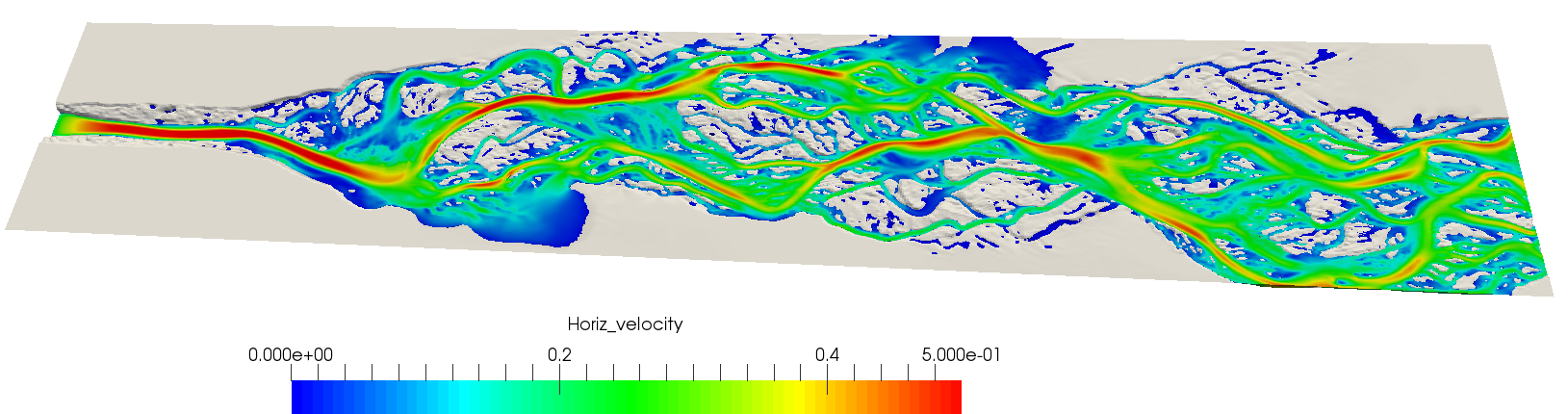
The picture above shows the results from modelling a braided laboratory channel.
Dr. Elena Pummer
Associate Professor
Subhojit Kadia
Modelling sediment flow with OpenFOAM
Prof. Jochen Aberle,
Technical University of Braunschweig, Germany
Energy losses in rock-blasted tunnels
Dr. Catherine Wilson, Cardiff University, UK
Modelling scour under leaky barriers
Prof. Thorsten Stösser, University College London, UK
Studies of RANS vs LES in hydraulics
Dr. Helmut Knoblauch,
University of Graz, Austria
Modelling sediments in reservoirs
Dr. Stefan Vollmer, Bundesanstalt für Gewasserkunde, Germany
Modelling sediment maintainence in rivers
Dr. Katinka Koll, The Technical University of Braunschweig, Germany
Modelling scour around trees in rivers
Dr. Gudrun Hillebrand, Bundesanstalt für Gewasserkunde, Germany
Modelling sediments in reservoirs and plastic particles in rivers.
Dr. Stefan Haun, University of Stuttgart, Germany
Modelling reservoir flushing.
Dr. Peggy Zinke, Sciencemonastry AS, Norway
Modelling water and sediment flow in the delta of Lake Øyern
Dr. Sandor Baranya,
Budapest University of Technology and Economics, Hungary
Modelling sediment transport and erosion in rivers.
Dr. Gabriele Harb, Verbund hydropower company, Austria
Modelling sediments in reservoirs
Dr. Kari Bråtveit, Hydro Energy
Modelling water flow in sand traps
Dr. Irina Klassen, Bundesanstalt für Wasserbau, Germany
Modelling sediments in rivers and reservoirs.
Dr. Francisco Núñez-González, Universitat Polytecnica de Catalunya, Spain
Modelling antidunes
Dr. Clemens Dorfmann, Flow engineering, Austria
Modelling sediments in reservoirs
Oscar Jimenez, DLZ, Costa Rica
Modelling sediment flow in reservoirs
Laura Lizano, Instituto Costarricence de Electricidad, Costa Rica
Modelling sediment flow in reservoirs
Pravin Aryal, Ministry of Energy, Water Resources and Irrigation, Nepal
Modelling water flow in sand traps
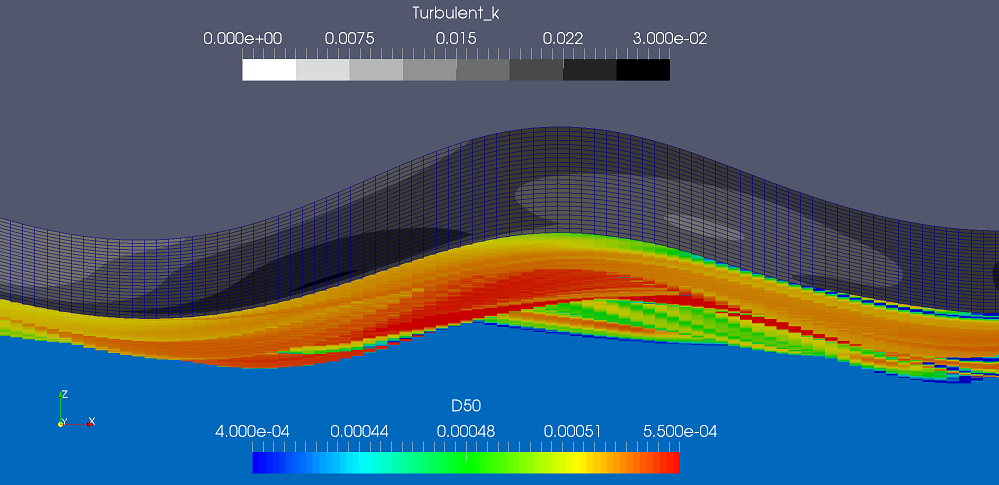
The picture above shows a longitudinal profile of sediment deposition with antidunes. The grey area is the water, showing
turbulent kinetic energy with the greyscale. The coloured area is the average sediment diameter of the bed.
More information and download instructions for SSIIM
We have also made a sediment solver for OpenFOAM.
More information and download instructions for sediDriftFoam
"Computational Fluid Dynamics for Hydraulic and Sedimentation Engineering" was made for the CFD part in our class "Withdrawal of water from sediment-carrying rivers". The class notes provides a simple introduction to the basics of CFD. The latest version was made 16. June 1999.
User's manual for SSIIM (3.5 MB PDF)
The user's manual for SSIIM provides standard information about the SSIIM program, like user interface, data format for input and result files etc. The latest version was made 21. April 2018.
Numerical modelling and hydraulics (1.7 MB)
The class notes for a course with the same name, given for the first time in the spring 2001. It is an undergraduate course in the 4th year of the Civil Engineering study at NTNU. This is the version from March 2012.
CFD Algorithms for Hydraulic Engineering (678 kB)
The book is a more detailed documentation of general and special hydraulic engineering CFD algorithms. It is intended to be used as a textbook for graduate courses in CFD, and also to provide assistance for people writing CFD codes. The present version is from 14. December 2000, and before this date it has not been checked by anyone but the author.
CFD for Hydraulic Structures (535 kB)
The book is about experiences using the SSIIM model to compute flow in/around hydraulic structures. The following cases are discussed: Vegetation, spillways, local scour and intakes. The present version is from 8. May 2001.
  |
Updated: 2. June 2023 |
 |